Computer vision for physical operations
The same floor,
understood.
Neuvis turns the cameras you already have into a measured 3D model of your floor. It sees what single models miss and measures work, not people.


The twin marks 5 people with their posture and pins 3 containers with their build stage: two open frames and one plated.
People 5 · Containers 3 · Stage build
No faces stored
Drag or use ← → to compare
01 · Why
01 · Why
Cameras record everything and understand almost nothing. Neuvis reads the cameras you already have and turns them into a measured model of your floor.
Inspection still depends on people watching screens and on spot checks. The footage exists; nobody has time to read it. Neuvis does the reading, and a person on your team decides what happens next.
02 · How Neuvis sees
Six stages, one frame.
One camera frame from a container fabrication bay, rebuilt as a twin. Each stage adds one layer, so you can see what it contributes.
Schematic. Shown on the twin frame; overlays are drawn from the scene file.
A fast detector finds the obvious people. Small figures in the far bay are easy to miss at this stage.

- 01
Detect
A fast detector finds the obvious people. Small figures in the far bay are easy to miss at this stage.
- 02
Tile
The frame is cut into overlapping tiles and read again at full resolution. Far-bay people now register.
- 03
Segment
Boxes become pixel masks, so measurements follow the body, not a rectangle around it.
- 04
Verify
A second model checks every candidate. Posts and gas cylinders that look like people are rejected.
- 05
Pose
Posture comes from body keypoints: standing, walking, crouching to weld.
- 06
Measure
People are counted against station polygons, so time is measured per station, not per person.
03 · Where it works
One system, four kinds of floor.
- 01Deployed pilot
Manufacturing
Fabrication bays, welding stations, assembly lines.
- Crew time per station and stagePilot · in audit
- Unmanned and idle station timePilot · in audit
- Forklift and pedestrian proximityPilot
- 02Ready
Security
Perimeters, gates, yards and parking after hours.
- Line crossing after hoursReady
- People in restricted zonesReady
- Tailgating at the gatePilot
- 03Pilot
Logistics
Container yards, docks and warehouse aisles.
- Container time between zonesReady
- Dock and bay occupancyReady
- Container ID readingRoadmap
- 04Pilot
Retail
Supermarkets: aisles, checkouts and entrances. No face recognition, no demographic estimates.
- Checkout queue lengthModel ready
- Aisle dwell timeModel ready
- Empty shelf detectionRoadmap
Deployed: running at a customer. Ready: models built and tested. Pilot: needs a customer pilot to validate. Roadmap: not built yet.
04 · Your site in 3D
Every camera, placed and measured.
Before anything is detected, Neuvis rebuilds your site as a calibrated 3D twin from the camera views you already have. That tells you what each camera can actually see.
- 01
Coverage map
Where each camera can detect, observe or recognise, based on pixel density across the floor.
- 02
Blind spots
The areas no camera covers, drawn on the plan before a cable is moved.
- 03
Night audit
Which cameras still work after dark: infrared range, lighting and glare, checked camera by camera.
05 · Privacy by design
We measure work, not people.
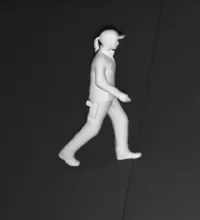
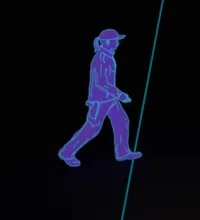
The same person at each step. Identity is removed before anything is measured.
- 01
No faces
Neuvis does not recognise faces. Faces are never stored or matched, and it does not estimate age or sex.
- 02
Stations, not individuals
Crew time comes from station polygons. Counting people in a station does not need to know who they are.
- 03
A person decides
Every alert waits for a supervisor to review it. Nothing reaches payroll or HR automatically.
06 · Edge, not cloud
Video stays in the building.
The models run on a compact computer on your network, next to the cameras. Only events and short clips leave the site, and only to the systems you choose.
- Your site network01
Your cameras
The IP cameras already installed. No new hardware on the walls.
02Neuvis edge box
Runs the six-stage cascade locally.
Available for pilots - 03
Your systems
Events and short clips to a review queue, your VMS or your MES.
07 · Proof
A steel container fabricator in northern Mexico.
The first deployment runs on the plant’s existing cameras. Neuvis rebuilt the halls as a calibrated twin, mapped the work stations and tracks each roll-off container through its stages.
| Cameras | Existing CCTV, no new installs |
|---|---|
| Twin | Calibrated from the camera views |
| Stages tracked | Armado → Pintura → Curado (build, paint, cure) |
| Measured | Crew time and idle time per station |
Results
Pilot results in review.
We publish a number only once it has been audited. Two people label the footage independently and every figure keeps its receipt.
Methodology: independent double labelling · audited before publication · customer named only with written consent.
Show us your hardest camera.
Tell us about the site and the camera that gives you the most trouble. We reply within one business day.